Holiday merch with a mission works best when the gift is useful and the giving commitment is specific. Before printing a charitable message, confirm who benefits, what support has been approved, who provides it, and how the results will be documented. Then choose merchandise and packaging that help tell that true story.
A company donation, a product with a supplier giving program, and apparel supplied for a community event are different forms of support. Each can have a place in holiday gifting, but they should not be described as though every purchase automatically produces the same charitable outcome.
If you are planning a seasonal program, explore JNP’s corporate holiday gifting services. Bring the gift brief and any approved charitable commitment together so the merchandise, message, and delivery plan can be coordinated from the start.
Decide what the mission actually means
Start with a cause connected to your company, team, or community. Ask the organization what support would be useful rather than designing a campaign around assumptions. A partner may need unrestricted funding, particular supplies, volunteer support, or help making an event recognizable. Merchandise should serve that need, not create additional work for the people receiving it.
Put the proposed arrangement into one plain sentence before choosing a slogan. For example, your company may be making a fixed donation alongside its annual client gifts. In that case, the gift celebrates the commitment; receiving or using the gift does not necessarily trigger another donation.
| Program approach | What to confirm | What the message should explain |
|---|---|---|
| A company-funded donation alongside gifts | The approved recipient, amount, timing, and payment owner | That the company is making the donation separately from the gift |
| A contribution tied to qualifying purchases or gifts | The exact trigger, calculation, dates, limits, and responsible business | How the qualifying activity changes the contribution |
| A supplier’s established giving program | The current eligible products and documented program terms | Who makes the contribution and which purchase qualifies |
| Merchandise for a community event | The requested items, quantities, artwork permissions, and delivery plan | The actual role of the merchandise without inventing donation results |
These are planning options, not promises attached to every JNP order. Any charitable component needs its own confirmed arrangement.
Make charitable gifting claims clear and credible
“Giving back with every gift” sounds reassuring, but it leaves important questions unanswered. Who receives the support? Is the contribution fixed or dependent on sales? Is there a maximum? Has the contribution already been made, or is it a future commitment?
BBB Wise Giving Alliance’s cause-marketing guidance recommends identifying the amount or portion of the purchase that benefits the charity, applicable campaign dates, and any maximum or guaranteed minimum contribution. It also recommends a written agreement covering the charity’s name or logo, the contribution, and when funds will be distributed. These are useful transparency principles when a promotion connects a sale to charitable support.
- Name the beneficiary accurately: use the organization’s approved name and description.
- Identify who gives: distinguish the buyer, merchandise supplier, employer, and recipient.
- Describe the calculation: make the amount or percentage and its basis understandable.
- Explain the boundaries: include relevant dates, eligible items or actions, and any cap or minimum.
- Match the wording to the status: “will contribute” and “has contributed” mean different things.
- Keep the evidence: retain the approved commitment and confirmation of completion.
Have the people responsible for the charitable arrangement approve the wording before it is printed. A merchandise proof confirms the design; it does not independently verify that a contribution has been made.
A real JNP example: Hearts & Hoops
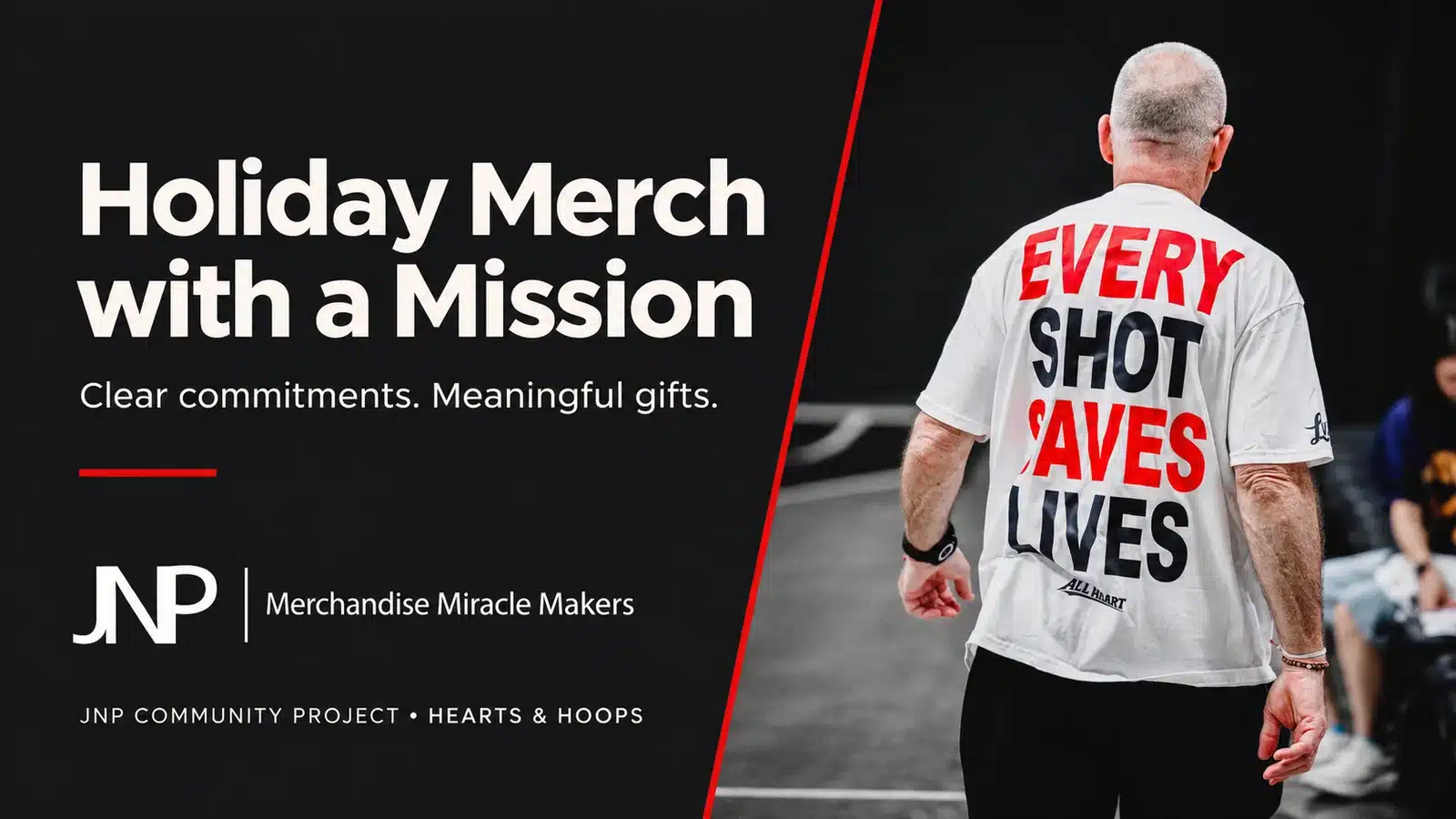
JNP’s Hearts & Hoops “Every Shot Saves Lives” project brought custom All Heart apparel into a community basketball fundraiser with CPR awareness. JNP’s published project story describes apparel for players, families, and volunteers, with the event led by Jason Levy.
The photograph featured here comes from that actual project. It shows how a clear message on a useful garment can connect participants to an event’s purpose. It is not a photograph of a holiday gift campaign, and it does not mean that ordering a similar shirt automatically creates a donation.
For a holiday program, the transferable idea is simple: build the message around a real activity and explain the merchandise’s role accurately. See more of JNP’s community work and giving-back projects for examples of how products can support people coming together.
Choose gifts people will use
A charitable story should complement a thoughtful gift. Ask what recipients will actually use, how they will receive it, and whether the item fits their routines. A smaller, well-chosen assortment can be more practical than a large kit with unrelated products.
- Drinkware: consider capacity, lid style, cleaning needs, and the recipient’s daily setting.
- Apparel: confirm size choices, comfort, decoration placement, and a practical exchange or exception plan.
- Totes and organizers: match the construction and size to a genuine carrying or storage need.
- Desk accessories: choose items relevant to the work environment rather than assuming everyone uses the same setup.
- Event merchandise: prioritize what volunteers or participants need for the activity, with the organizer’s input.
Useful merchandise can keep a message visible after an occasion. That is different from proving that a gift increases loyalty, improves morale, or produces a specific charitable outcome. Measure those results separately if they are objectives of your program.
Keep the cause and branding in balance
Choose one main message and give it room. A company logo, a partner logo, a campaign slogan, a holiday greeting, and a donation explanation do not all need to compete on the product itself. A simple item paired with a clear insert often gives the recipient a better reading experience.
Confirm permission and approved artwork before using a partner’s name, logo, or project photographs. Keep attribution clear so the design does not suggest an endorsement or relationship beyond the arrangement that actually exists.
A short note can explain the occasion, the confirmed commitment, and where to find more information. If a QR code is included, test its destination before production and keep the page available after the campaign. Put the essential facts on the note itself so recipients do not need to scan just to understand the claim.
For the physical presentation, use JNP’s guide to custom packaging for event and holiday gifts. Select the format for fit, protection, and delivery before adding decorative details.
Plan the charitable commitment and merchandise budget separately
Give the donation and the gifting program their own budget lines. Include merchandise, decoration, cards, packaging, assembly, delivery, and the agreed charitable support. This makes it easier to see whether a design change affects the gift budget, the contribution, or both.
A purchase-linked commitment needs a clear owner for counting the qualifying activity and reconciling it after the campaign. If the contribution is fixed, avoid language suggesting that additional recipient engagement increases it. If the arrangement includes matching, record the match limit, eligible actions, and completion deadline before announcing it.
Recipients should be able to enjoy the gift without feeling pressured to donate, share a social post, or disclose a personal cause preference. If you offer an optional way to participate, make that choice clear and explain what happens when someone does nothing.
Build an approval and delivery plan that can be completed
Holiday timing involves more than the carrier’s transit estimate. Confirm product availability, artwork approval, decoration, assembly, and destination receiving arrangements. Leave time for the organization involved to review its name and the charitable wording.
JNP’s holiday gifting timeline can help organize those stages. The actual production and arrival dates still need confirmation for the selected products and delivery locations.
- Confirm the arrangement: beneficiary, contribution owner, commitment, permissions, and reporting plan.
- Approve the gift assortment: quantity, sizes or variants, budget, and required arrival date.
- Approve the complete message: review the product, card, packaging, and linked page together.
- Check the final proof: spelling, logos, dates, contribution language, and QR-code destination.
- Coordinate fulfillment: recipient lists, kit versions, shipping, and exceptions.
- Close the loop: confirm delivery and the charitable commitment separately.
Use JNP’s proofing and approval checklist for the artwork review. If components are changing late, simplify the design rather than printing a claim that has not been confirmed.
Report what happened, not what you hoped would happen
After the program, separate activity from outcomes. Gifts shipped, event attendance, funds transferred, and outcomes reported by a beneficiary are different measures. Keep their dates and sources clear.
A brief follow-up can thank participants, state what was completed, and link to an approved update. If an outcome has not yet been reported, say that rather than converting a donation amount into an invented number of meals, people helped, or other benefits. Use the beneficiary’s documented methodology for any such calculation.
You can also learn from operational details: which gifts were useful, whether the explanation was understood, and whether deliveries arrived as intended. Those findings can improve the next program without turning charitable support into an exaggerated marketing claim.
Bring JNP a clear holiday gifting brief
Share your audience, quantity, budget, product preferences, delivery locations, and desired arrival date. Include the beneficiary’s approved name, any confirmed giving terms, the person authorized to approve them, and the project imagery you have permission to use.
Talk with JNP about a holiday gifting program with a clear purpose. We can help coordinate the merchandise and presentation around the arrangement you have confirmed, so the gift is useful, the message is understandable, and the story reflects work that actually happened.