Bulk thank-you gifts are coordinated appreciation orders for a group of clients, employees, partners, or supporters. Start with the recipient list, occasion, total budget, and delivery plan. Then choose useful gifts and a message that fit each group. Ordering in bulk should simplify the process without making the thank-you feel impersonal.
A thoughtful order needs more than a product choice. Someone must approve the artwork, confirm quantities, check recipient preferences, and decide how the gifts will reach people. This guide helps you turn those decisions into a brief that a merchandise team can quote and execute.
Define Who You Are Thanking and Why
Write one sentence describing the contribution you want to recognize. A project milestone, a year of partnership, and an employee anniversary call for different messages. That sentence becomes a useful filter: if an item has no connection to the recipient or occasion, a large logo will not make it more meaningful.
Group recipients by practical needs, not just seniority. Employees at one office may receive gifts in person, while clients need individual deliveries. A shared item can work across both groups, but the card, packaging, or shipping arrangement may differ. Keep the number of variations manageable.
- Employees: consider everyday usefulness, consistent recognition, and who will be absent on distribution day.
- Clients and business partners: check gift-acceptance policies and whether a personal or shared-office gift is appropriate.
- Speakers, volunteers, or supporters: connect the message to their contribution and the organization they helped.
JNP’s custom branded gifting service covers corporate and event gift boxes, product sourcing, packaging, and shipping. Bring the recipient context into that conversation before requesting a list of products.
Compare Bulk Thank-You Gift Options by Recipient Fit
Use product categories to narrow the brief rather than treating every catalog item as a candidate. Availability, decoration, minimum quantities, and pricing need confirmation for the specific order. These options are planning directions, not a promise that a particular item is ready to ship.
| Gift direction | When it may fit | What to check before ordering |
|---|---|---|
| Drinkware | Daily use at work, home, or on the commute | Size, cleaning instructions, decoration placement, and packaging |
| Notebooks and writing instruments | Meeting-heavy teams, speakers, and professional partners | Paper format, writing feel, branding size, and whether a set adds useful value |
| Totes and travel accessories | Events, commuting, or recipients carrying work essentials | Actual capacity, material, portability, and suitability for the audience |
| Food or beverage gifts | Recipients whose preferences and restrictions are known | Ingredient information, storage needs, delivery conditions, and appropriate alternatives |
| Tech accessories | Recipients with a clearly understood practical need | Compatibility, manufacturer specifications, and whether the item solves a real problem |
| Curated gift boxes | A milestone or appreciation moment that benefits from coordinated presentation | Every component, packing requirements, and whether the contents form a coherent gift |
For a mixed audience, favor a broadly useful item over a highly specific personal choice. Apparel adds sizing decisions; a gadget may depend on a device the recipient does not own. A smaller selection that suits the group is easier to approve and more considerate than a box filled to meet a perceived item count.
Make Food and Beverage Choices Carefully
Ask about suitability before choosing consumables. The FDA recommends reading food labels for allergen information and checking with the manufacturer when ingredients are unclear. Do not infer dietary suitability from a product name or packaging photograph.
Offer a nonfood alternative when that makes the program more inclusive. Alcohol is also a recipient-specific choice, not a default corporate gift. Confirm the organization’s policies and the proposed fulfillment arrangement before including it.
Set an All-In Budget Before Comparing Quotes
Start with a total approved amount and a realistic recipient count. The product price alone does not describe the cost of a finished gift. Decoration, setup, packaging, assembly, shipping, and applicable taxes may affect the final quote. Ask which charges are included and which remain estimates.
Compare proposals using the same specifications. A quote for one office delivery is not directly comparable to a quote for individual parcels. Likewise, a shared printed message and a unique engraved name for every recipient are different production requirements.
- Confirm the quantity for each product and variation.
- Separate essential presentation details from optional extras.
- Ask how substitutions would affect cost and appearance.
- Confirm the cost of any extras, replacement shipments, or address corrections.
- Check the quote’s approval requirements before announcing the program.
Do not assume ordering more automatically produces a lower total cost. Unneeded gifts still use budget, storage, and staff time. Request an appropriate spare quantity based on the distribution plan rather than adding an arbitrary percentage.
Personalize the Thank-You Without Complicating Every Gift
Personalization can come from the message as well as the product. A shared gift with a note explaining the recipient’s contribution may communicate more than another imprint location. Decide whether the branding belongs on the item, the packaging, the card, or a combination of these.
Individual names require a checked list and a process for matching each finished gift to the right recipient. If the organization cannot maintain that list reliably, a shared design with a carefully written message may be a better choice. Assign one person to consolidate feedback and approve the final wording.
A Real JNP Thank-You Project
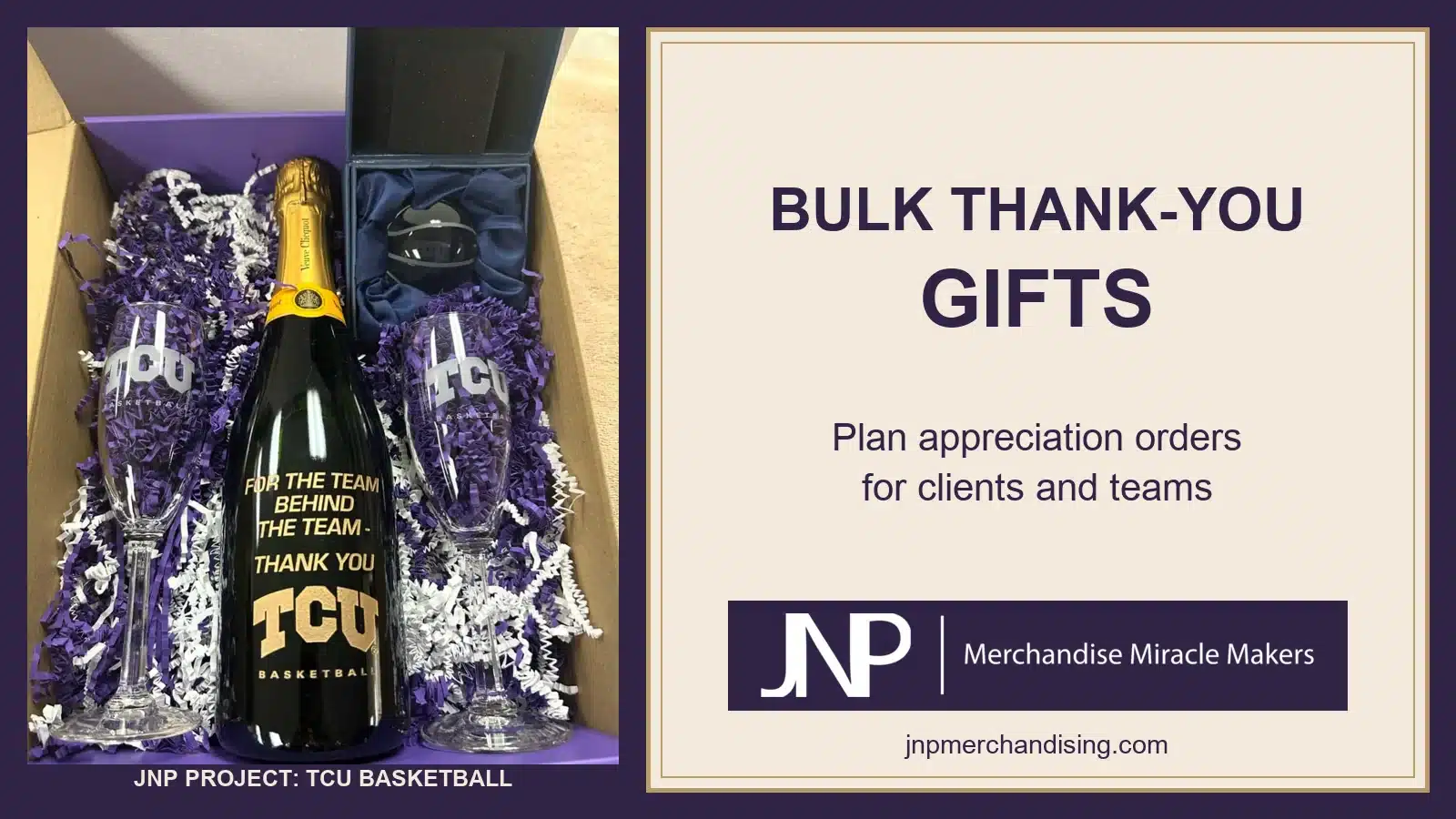
JNP’s TCU Basketball donor thank-you gift box combines program-specific packaging, engraved items, and a message recognizing the supporters behind the team. The portfolio documents sourcing, packaging design, engraving coordination, and fulfillment.
The useful lesson is the connection between the recipient, message, and presentation. This particular project is not a universal gift recommendation, a current product offer, or evidence of a particular order quantity or turnaround. Apply the same planning principle with items appropriate for your own audience.
Choose the Delivery Model Before Finalizing Products
An office handout and a multi-address program require different preparation. For an office, confirm who receives the shipment, where it can be stored, and how gifts reach remote or absent colleagues. For individual deliveries, confirm the address collection process and who handles corrections.
Keep recipient information in an approved, access-controlled file. Share only what is needed to fulfill the order and agree on the transfer method with the team handling it. Avoid collecting addresses in a public document or spreading multiple conflicting versions through email.
Work backward from the date people need the gift in hand. Artwork approval, product availability, decoration, packing, and transit are separate steps. Ask for a project-specific schedule that includes them. A carrier delivery estimate is not a substitute for confirmation that production can finish on time.
For seasonal recognition, JNP’s corporate holiday gifting programs provide a relevant next conversation. If Thanksgiving is the occasion, use the dedicated corporate Thanksgiving gifting page for that seasonal context rather than treating every appreciation order as a holiday campaign.
Keep Summer Employee Gift Bags Focused and Useful
A summer thank-you can still fit this approach. Consider a useful bottle, tote, or picnic accessory when it matches how the group will use the gift. Avoid combining unrelated products simply because they share a seasonal theme. Confirm product specifications rather than assuming protective or performance claims.
Seasonal items are most helpful when the distribution date supports their use. If an outdoor event is the occasion, think about what attendees can comfortably carry. For a broader employee program, ask whether the gift remains useful to colleagues who will not attend that event.
Prepare a Quote-Ready Bulk Gifting Brief
Send the key decisions together so proposals can address the real assignment. A brief should include:
- The occasion and contribution being recognized.
- Recipient groups, quantities, and relevant preferences or restrictions.
- The all-in budget range and any approval limits.
- The required arrival date and delivery locations.
- Two or three preferred product directions and acceptable alternatives.
- Approved artwork, message wording, and the person who signs off.
Before production, check the proof against the agreed item, decoration, message, quantity, and delivery plan. If something changes after approval, ask how it affects cost and timing. Keep the final decision in one place so the buyer, approver, and fulfillment team work from the same instructions.
Common Questions About Bulk Thank-You Gifts
What Is the Minimum Order Quantity?
It depends on the item, supplier, and customization. Share your actual recipient count and ask which options fit it. A minimum for one product does not establish the minimum for an entire gifting program.
Should Clients and Employees Receive the Same Gift?
They can if the item suits both groups and their policies permit it. Adapt the message to the relationship. Create separate versions only where they improve suitability, recognition, or distribution enough to justify the extra work.
Can Every Gift Have a Different Name or Message?
That needs confirmation for the chosen product and schedule. Variable personalization introduces file preparation, proofing, and matching requirements. Ask what is feasible before collecting personalized requests from recipients.
Turn Appreciation Into a Manageable Order
The strongest bulk thank-you program combines a clear reason for giving, useful items, an appropriate message, and a workable handoff. Decide those elements before expanding the product list. That gives your team a better basis for evaluating both the gift and the proposal.
Send JNP your appreciation-gifting brief with your recipient count, budget range, desired arrival date, and delivery plan. The team can evaluate suitable sourcing and customization options; final availability, pricing, and timing belong in the project quote.